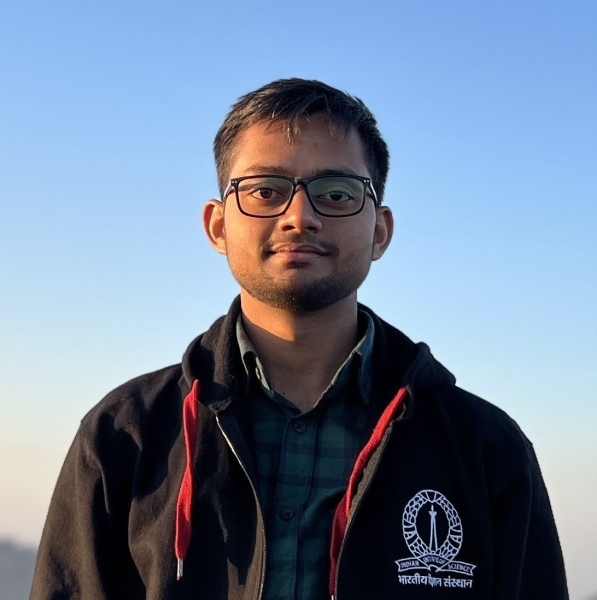
Saurabh Kumar - Researcher in Speech Processing and Machine Learning
Welcome to my personal webpage! I am an M.Tech. (Research) student in Electrical Engineering at the Indian Institute of Science (IISc), Bengaluru, where I work at the SPIRE Lab under the guidance of Prof. Prasanta Kumar Ghosh.
I am looking for research internship opportunities for summer 2027 (about 3 months, May–July), in India or abroad, and I am open to research collaborations. If my profile interests you, please reach out at saurabhk0317@gmail.com.
My research focuses on automatic speech recognition (ASR) and dialect identification (DID) for low-resource Indian languages. I am interested in how auxiliary tasks such as dialect and domain identification can be used to improve ASR, and in building reproducible pipelines for curating and quality-checking speech corpora at scale. More recently, I have started working on speech-to-speech translation for low-resource Indian languages.
Before starting my M.Tech. (Research), I was a Research Associate at the SPIRE Lab (2021–2026) and a Machine Learning / Signal Processing Consulting Engineer at ARTPARK @ IISc (2022–2026). I hold a B.Tech. in Electronics and Communication Engineering from the National Institute of Technology (NIT), Patna.
Research Highlights
- Robust ASR training (M.Tech. research): Proposed a CTC training criterion with token-level wildcard arcs that tolerates localized transcription ambiguity (pronunciation, spelling, lexical variants), achieving a 9.45% average relative WER reduction over CTC across multiple languages and corpora (preprint, submitted to ICASSP 2027).
- RESPIN-S1.0 (NeurIPS 2025): First author of the RESPIN-S1.0 database paper at the NeurIPS 2025 Datasets and Benchmarks Track — a read speech corpus of 10,000+ hours across dialects of nine Indian languages. I led the large-scale data curation, reproducible benchmarking, and baseline ASR development.
- Dialect identification: Led the first large-scale study of DID in Indian languages (79.81% accuracy across 33 dialects), and developed a multimodal fusion model for joint ASR and DID reaching 4.65% CER with 81.63% DID accuracy.
- Low-resource ASR: Improved ASR through adapter-based domain adaptation (10–30% relative WER reduction across nine languages) and a gated multi-encoder model with frame-level gating (7.5% WER reduction on Bhojpuri, 9% on Bengali).
- Speech synthesis (SYSPIN): Built a Kaldi-based ASR data filtering pipeline that improved corpus quality for a text-to-speech system in nine Indian languages.
- Data curation (VAANI, NeurIPS 2026): Developed automated signal processing and machine learning pipelines for acoustic quality assessment, speech activity detection, and metadata validation, and established the acceptance criteria underpinning the open-source release of 31,000+ hours of speech from 156,000+ speakers across 109 languages. Co-author of the VAANI paper, to appear at the NeurIPS 2026 Evaluations and Datasets Track.
Challenges and Professional Service
I was the lead organizer of the MADASR 2.0 Multi-Lingual Multi-Dialect ASR Challenge at IEEE ASRU 2025, where I designed the challenge tracks, evaluation protocols, and public leaderboards, and developed the ESPnet-based baseline systems. I have also co-organized LIMMITS’24 (ICASSP 2024), MADASR (ASRU 2023), and the Gram Vaani ASR Challenge (Interspeech 2022).
I serve as a reviewer for ICASSP, IJCNN, Interspeech, IEEE ASRU and IEEE SLT, and for the journals Computer Speech & Language and Speech Communication. In 2022 I won the Best Hackathon Project Award at the SLT-CODE Hackathon for dialectal ASR systems in Bengali and Bhojpuri.
Skills
I am proficient in machine learning toolkits like PyTorch and Scikit-learn, and ASR frameworks such as ESPnet, Icefall, Kaldi, and Fairseq. I program in Python and Bash, and work with tools including Hugging Face, Linux, Docker, Git, MATLAB, Praat, Audacity, and LaTeX.
Elsewhere
See my publications and CV, or find me on GitHub, Google Scholar, ORCID, and LinkedIn.